

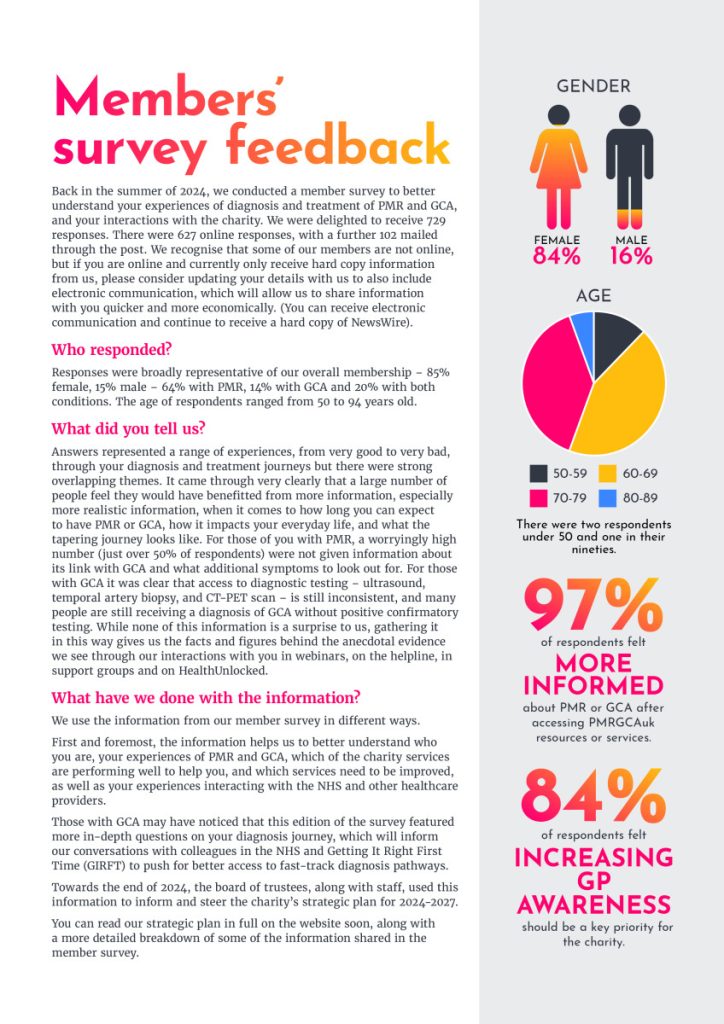
In the spring edition of our members’ magazine, NewsWire, we reported on some of the results of our member survey. Nearly everyone felt more informed about their conditions after accessing our information and services.
Less positively, two very strong themes came across in terms of patient experience. One related to the lack of information provided to patients with PMR at the time of diagnosis. This included things such as information on duration of the disease and the impact it might have on the patient’s life. Around half said they weren’t made aware of their higher risk for GCA.
The second theme was in the varying levels of access to diagnostic testing for GCA.
All of the information gathered helps us to help members and patients better. You can read more about the results and what we do with them in the full article from our magazine below. (A copy of the text appears below the page image.)
Members’ Survey Feedback
(Text from the above magazine article.)
Back in the summer of 2024, we conducted a member survey to better understand your experiences of diagnosis and treatment of PMR and GCA, and your interactions with the charity. We were delighted to receive 729 responses. There were 627 online responses, with a further 102 mailed through the post. We recognise that some of our members are not online, but if you are online and currently only receive hard copy information from us, please consider updating your details with us to also include electronic communication, which will allow us to share information with you quicker and more economically. (You can receive electronic communication and continue to receive a hard copy of NewsWire).
Who responded?
Responses were broadly representative of our overall membership – 85% female, 15% male – 64% with PMR, 14% with GCA and 20% with both conditions. The age of respondents ranged from 50 to 94 years old.
What did you tell us?
Answers represented a range of experiences, from very good to very bad, through your diagnosis and treatment journeys but there were strong overlapping themes.
It came through very clearly that a large number of people feel they would have benefitted from more information, especially more realistic information, when it comes to how long you can expect to have PMR or GCA, how it impacts your everyday life, and what the tapering journey looks like. For those of you with PMR, a worryingly high number (just over 50% of respondents) were not given information about its link with GCA and what additional symptoms to look out for.
For those with GCA it was clear that access to diagnostic testing – ultrasound, temporal artery biopsy, and CT-PET scan – is still inconsistent, and many people are still receiving a diagnosis of GCA without positive confirmatory testing. While none of this information is a surprise to us, gathering it in this way gives us the facts and figures behind the anecdotal evidence we see through our interactions with you in webinars, on the helpline, in support groups and on HealthUnlocked.
What have we done with the information?
We use the information from our member survey in different ways.
First and foremost, the information helps us to better understand who you are, your experiences of PMR and GCA, which of the charity services are performing well to help you, and which services need to be improved, as well as your experiences interacting with the NHS and other healthcare providers.
Those with GCA may have noticed that this edition of the survey featured more in-depth questions on your diagnosis journey, which will inform our conversations with colleagues in the NHS and Getting It Right First Time (GIRFT) to push for better access to fast-track diagnosis pathways.
Towards the end of 2024, the board of trustees, along with staff, used this information to inform and steer the charity’s strategic plan for 2024-2027.
You can read our strategic plan in full on the website soon, along with a more detailed breakdown of some of the information shared in the member survey.


